Enterprise Grid
A product offering from Slack.
What is it?
- A communication (or “collaboration”) solution for larger, more complex solutions
- It’s basically the same Slack that we use everyday, but with some really nice additional features for really large companies
- Only “collaboration” (probably IM / communication) product that can support up to 500k people
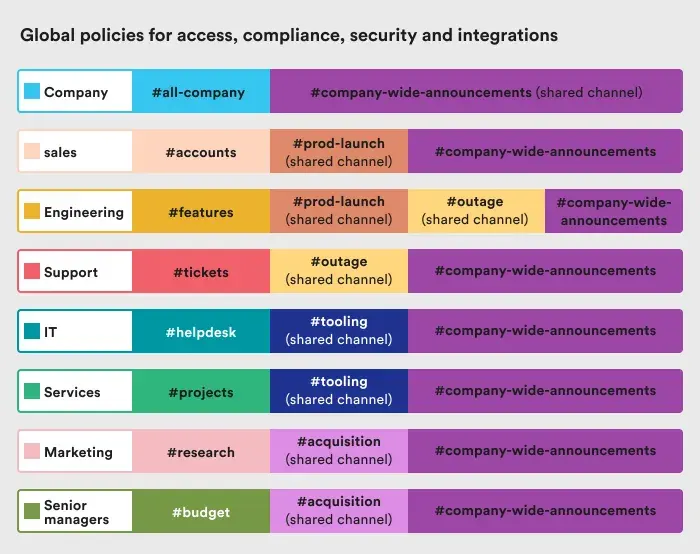
- Allows for creating unlimited Slack workspaces, all housed / contained in a “shell” organization
- You’ll usually create new, entire workspaces for different business units, departments, or subsidiaries
Grid enables teams to work with greater agility while providing IT admins with centralized tools to manage security and maintain compliance across the entire organization
- Example of Grid setup, channels shared across different workspaces, etc…
Value Props
- Same, great, simplified communications platform feel, with the complexity managed for you
- Allow for breaking up communication platform into smaller, more manageable chunks instead of having a behemoth that you have to deal with
- Employees can feel more agile/nimble, like they’re working in a smaller unit
- They also have access to shared channels for important information, and can search using granular filters
- Can still DM anyone in the entire company
- Yet, at the same time, IT can manage security / permissions / access to shared communication channels from a centralized location
- There can be hierarchies of admins:
- 1 or more for the entire organization
- 1 or more for each Slack workspace
- Can customize security policies for individual workspaces as needed
- Can delegate specific tasks (like approving guest accounts or adding integrations) to admins of individual workspaces
- There can be hierarchies of admins:
- 99.99% uptime SLA
- OOTB integrations with tons of different services that many enterprises use today
Security and Compliance Features
Various Slack products (including Grid) come with the following:
- Encryption at rest and in transit
- SSO (SAML and others)
- SCIM provisioning and real-time Activity Directory sync
- Important Note: SSO is actually required in Grid setups!
Grid additionally provides the following:
- Custom terms of service
- Custom message retention policies
- Domain claiming
- Enterprise Key management
- Also integrates well with other products for the following:
- Data loss prevention (DLP)
- E-discovery & archiving
- Enterprise mobility management (EMM)
- Security information & event management (SIEM)
Security & Regulatory Requirements Met
_Important Note: I actually don’t know if Enterprise Grid is the only product that has these regulatory approvals, or if all of Slack has this as well, regardless of the product…_
- SOC 2
- GDPR
- Criminal Justice Information Services (CJIS)
- FINRA
- Federal Risk & Authorization Management Program (FedRAMP)
- HIPAA
- Request requirements
- ISO IEC 27001 - Information Security Management System (ISMS)
- ISO IEC 27018 - Protection of Personally Identifiable Information (PII)
- IS/IEC 27017 - Cloud Computing Security
Migration to Grid
- Step 1 Intro Video to Enterprise Grid and the Migration Process
- Step 2 Video: Setting Up Grid Org
- Step 3 Video: Understanding Grid Settings & Apps
- Pre-Migration Checklist
What’s Migrated?
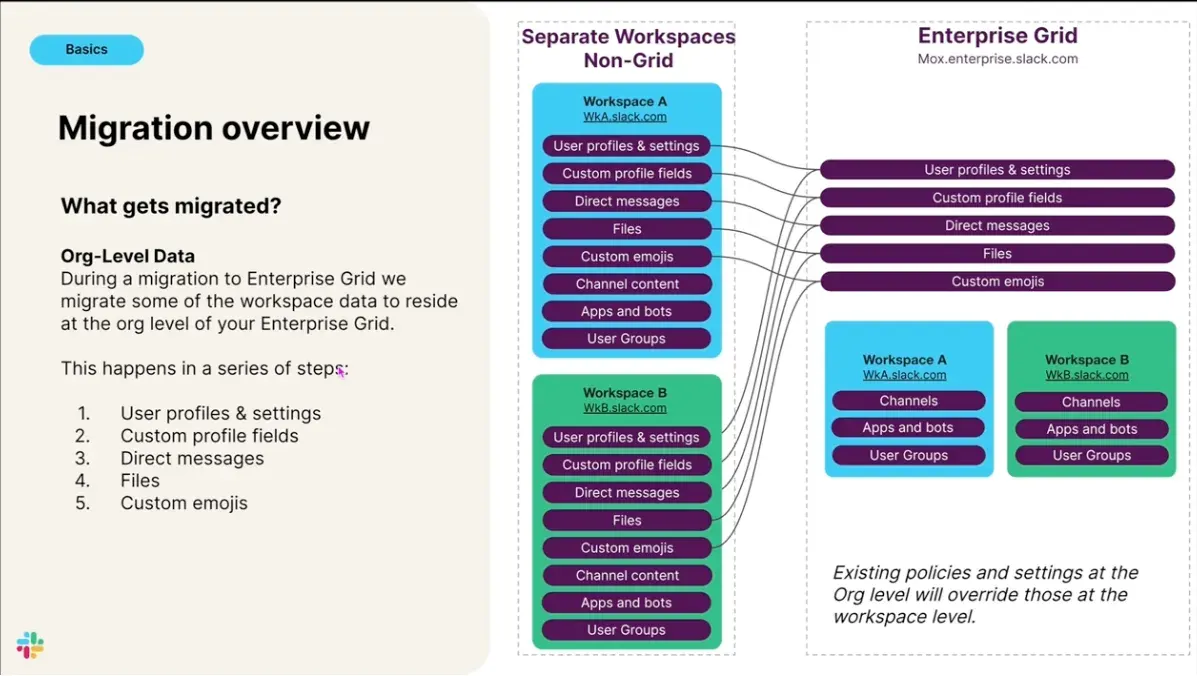
Org-level data from the previous “account” or Slack Org is migrated into the overall Enterprise Grid Organization settings in the following order:
- User profiles & settings
- Custom Profile fields
- DMs
- Files
- Custom Emojis
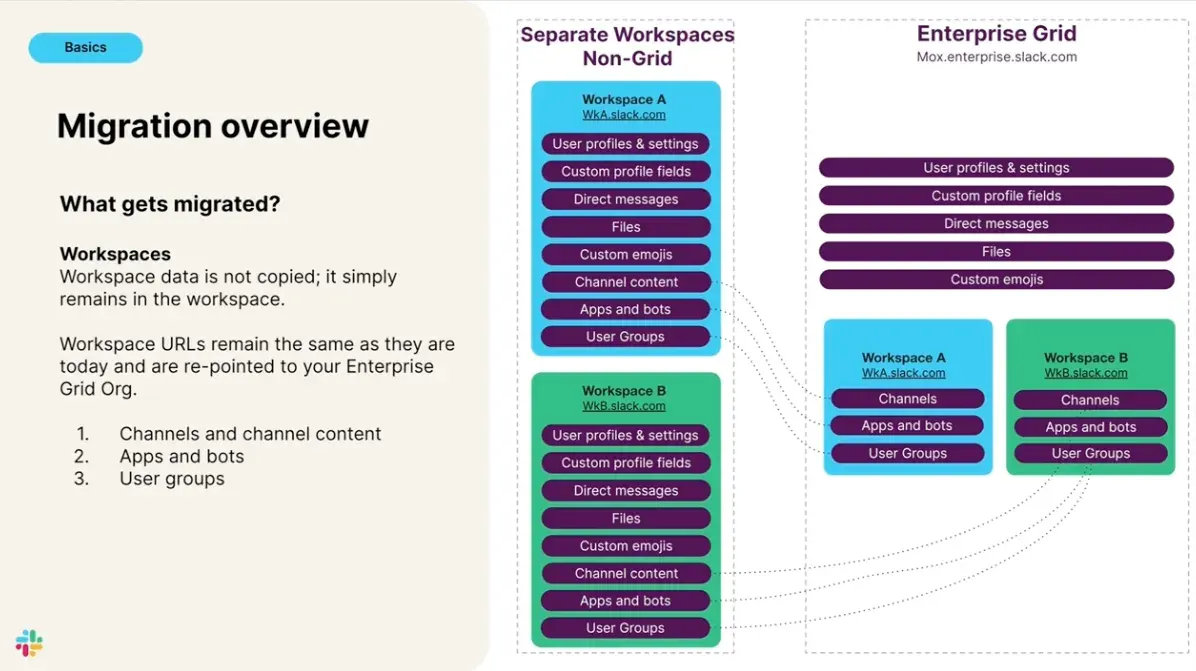
Workspace data is then made available (not copied, but migrated) to the new Enterprise Grid org
Important Notes on Migration
- Org-level policies override workspace-level policies
- Primary Org Owner role is an important part of the setup
- What happens to installed / configured Apps during a Grid migration?
- Almost all of them will be fine and migrated over
- 2 exceptions: Any apps that use the following APIs will need to be reconfigured:
- Discovery
- SCIM
- If you have custom-built apps, those will also be migrated but you should review your code to make sure that it would work in a multi-workspace environment